
Timber traceability software: how to simplify control of your forest supply
Having timber traceability software is not a technology question. It is a strategic decision to improve management, reduce risks and gain competitiveness.
By Nemus Team
Picture this: a driver can’t find the delivery note for yesterday’s load, the purchasing manager doesn’t know how many tonnes are still available in the batch, and the admin team has spent half the morning looking for the weighing ticket from three weeks ago. Everyone is working, nobody stops, but the critical information is not where it should be.
This scene, more common in the forestry sector than it seems, reflects a structural problem: timber traceability still depends on paper, WhatsApp messages and spreadsheets that are not connected to each other. And when an audit or a customer claim arrives, everything turns into a puzzle that is hard to solve.
Why traceability is no longer optional
The forestry sector is under growing regulatory pressure. The EUDR requires you to prove that the timber you place on the European market is deforestation-free. Certifications such as PEFC, FSC and SURE demand verifiable documentation along the whole chain. Industrial customers increasingly ask for transparency about where their supply comes from.
On top of that, information is usually scattered: the forest manager has data in their head and on their phone, the driver carries paper delivery notes, the yard records incoming loads on a sheet, and the office tries to make everything add up at the end of the month. When something goes wrong, tracing the error costs time and credibility.
The problem of control based on experience
Many forestry operations run thanks to the knowledge of key people who have been in the sector for years. That knowledge is valuable, but also fragile: when that person is not available, the information is not systematised and decisions are made with incomplete data.
When you depend on personal knowledge instead of documented processes, errors take longer to detect, costs swell and your ability to prove compliance to third parties is compromised.
What forest traceability software should offer
Not every management software works for the forestry sector. A timber traceability system must be able to:
- Manage forest batches from the origin, with information on the forest, the owner and the certifications.
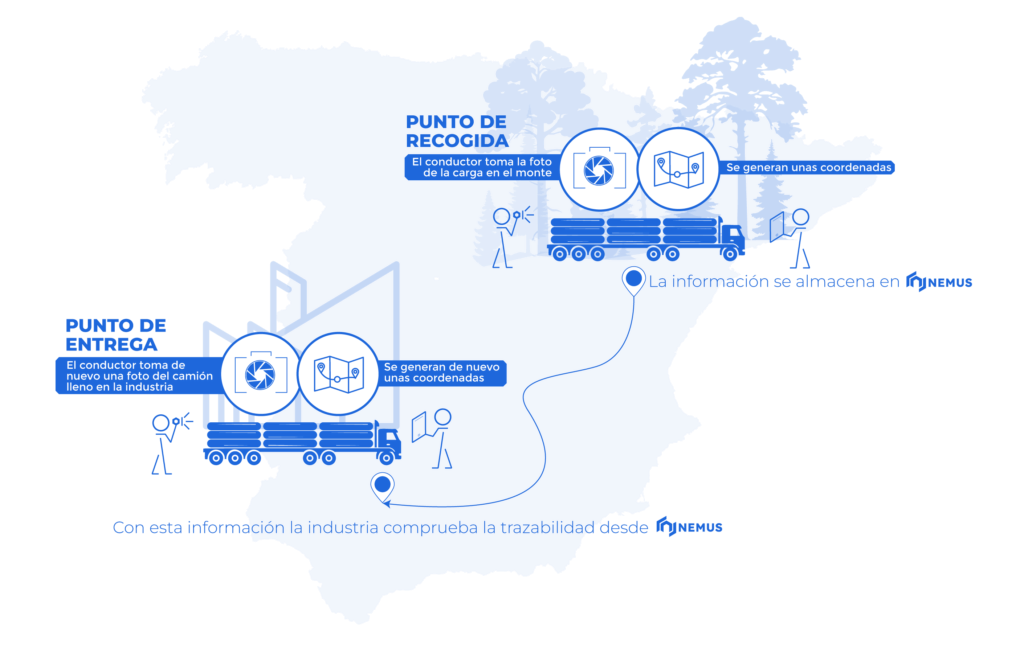
- Record and georeference extraction points, linking each load to a verifiable location.
- Track the tonnage extracted and in transit in real time.
- Integrate transport, digitalising consignment notes and weighing tickets.
- Generate EUDR compliance documentation with no extra work, from the data already recorded.
- Be accessible from the field, without requiring complex technical training or expensive installations.
All in a single environment, not in five different applications that don’t talk to each other.
How Nemus solves this problem
Nemus is a platform designed specifically for the forestry sector. It lets you document each batch from the forest to the industry, centralise the information of all the parties involved (owners, harvesting contractors, drivers and industry) and generate EUDR codes automatically from the georeferencing data you have recorded.
The Trucker app, built for use in the field, lets the driver record loads in real time, geolocate the harvesting and weighing points, and generate the digital transport note at the moment of loading. No paperwork, no calls to confirm data, no duplicated work.
Beyond compliance: the operational advantages
Implementing forest traceability software is not only useful for passing an audit. The operational benefits are immediate:
- Fewer administrative errors in delivery notes, work reports and weighing records.
- Less management time for the office team and the forest managers.
- Early detection of inefficiencies that used to stay hidden on paper.
- Decisions based on real data, not on estimates or memory.
The time to act is now
Adopting traceability software before regulatory pressure peaks lets you make the transition gradually and in an orderly way. The team learns to use it without rush, processes adapt over time, and when the next audit or the next demanding customer arrives, the documentation will be ready.
Waiting until it becomes mandatory usually means implementing in a hurry, making mistakes and taking on avoidable costs.
Request a Nemus demo and see how to simplify control of your forest supply.